TL;DR Two recent works attack hallucinations from different angles. OpenAI explains why overconfident errors persist—our training and evaluation norms reward guessing over “I don’t know”—and argues for abstention-aware benchmarks. Hassana Labs turns hallucination risk into a measurable quantity using an information-theoretic planner (EDFL/B2T/ISR) that gates answers when there isn’t enough evidence. Together, they point to a pragmatic future: fewer wrong answers, more calibrated refusals, and deployable controls. (OpenAI)
Why LLMs Still “Bluff”
OpenAI’s analysis links hallucinations to incentives across pre-training and post-training:
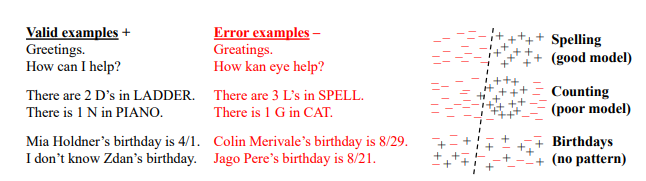
- Pre-training: Next-token prediction (cross-entropy) implies an inherent binary decision—is this candidate output valid?—which yields unavoidable error bounds even for strong models. (OpenAI CDN)
- Post-training & eval: Today’s evals rarely allow abstain/IDK and often reward confident guessing, teaching models to answer when uncertain. OpenAI argues benchmarks should permit IDK and penalize wrong answers more than refusals, realigning incentives toward honesty. (OpenAI)
Practical takeaway: If your metric punishes “I don’t know,” you’re training your system to bluff.
 Open full-size image
 Predicting (and Preventing) Hallucinations with Information Budgets
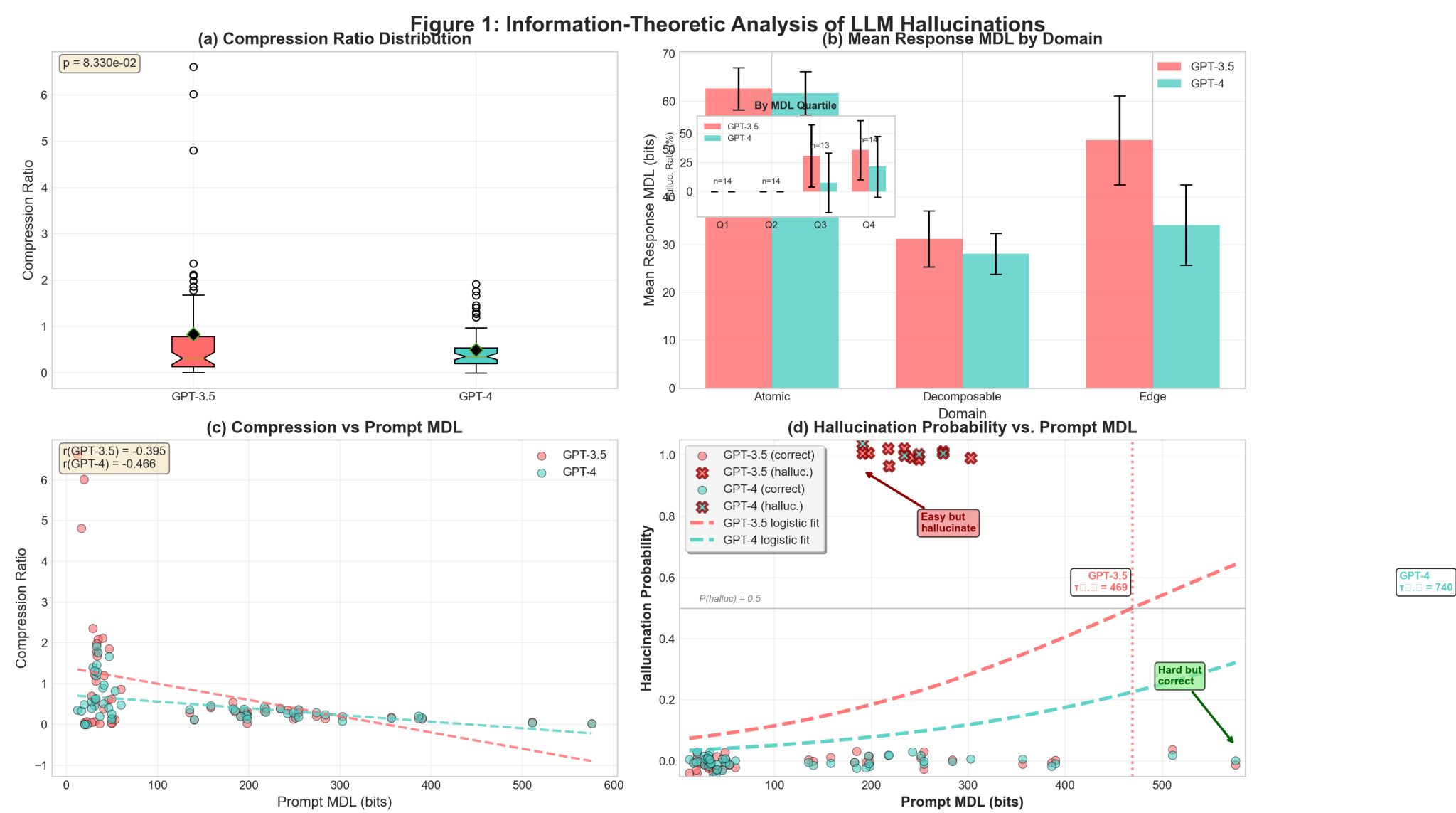
Hassana Labs frames hallucinations as predictable compression failures: models compress the world; rare facts and thin evidence make reliable recovery impossible. They propose EDFL (Expectation-level Decompression Law) and a deployable planner:
- B2T (Bits-to-Trust): How many bits of information are required to meet your target reliability (e.g., ≤5% hallucination rate).
- ISR (Information Sufficiency Ratio): Observed information lift divided by B2T.
- Decision rule: Answer iff
ISR ≥ 1(plus margin); otherwise refuse. - RoH (Risk of Hallucination): A bound on error given the measured info budget and priors.
In evaluations, a pre-specified ISR=1.0 policy achieved near-0% hallucinations with ~24% abstentions—trading coverage for reliability in a controlled, auditable way. (arXiv)
Why this matters: You get knobs you can turn—target error rates, margins, priors—without changing the base model. (GitHub)
 Open full-size image
 How the Two Fit Together
- OpenAI: Fix incentives upstream—train and evaluate so models aren’t pushed to guess.
- Hassana Labs: Add deployment-time safety rails that measure info sufficiency per query and gate answers.
Do both, and you shift from “hope it’s right” to “make it right or politely decline.” (OpenAI)
A Mental Model
 Open full-size image
 Decision flow: adjust training and evaluation so calibrated abstention is allowed; measure whether the evidence for this query is sufficient; answer only when the Information Sufficiency Ratio meets its threshold plus a safety margin; otherwise abstain or retrieve more evidence. Track coverage, accuracy when answering, and hallucination risk together.
Try It: HallBayes in 5 Minutes
The Hassana Labs repo includes a CLI and Python planner for OpenAI-compatible backends.
# 1) Clone
git clone https://github.com/leochlon/hallbayes
cd hallbayes

# 2) Set your OpenAI key
export OPENAI_API_KEY=sk-...

# 3) Quick single-prompt check (closed-book)
python scripts/quick_eval.py "Who won the 2019 Nobel Prize in Physics?"

# 4) Interactive mode
python scripts/quick_eval.py --interactive

# 5) Batch from file
python scripts/quick_eval.py --file prompts.txt --output results.json
Minimal Python example (closed-book policy, target ≤5% hallucination rate):
from scripts.hallucination_toolkit import OpenAIBackend, OpenAIItem, OpenAIPlanner

backend = OpenAIBackend(model="gpt-4o-mini")
item = OpenAIItem(
    prompt="Who won the 2019 Nobel Prize in Physics?",
    n_samples=7,      # stability
    m=6,              # number of skeletons
    skeleton_policy="closed_book"
)

planner = OpenAIPlanner(backend, temperature=0.3)
metrics = planner.run([item], h_star=0.05, isr_threshold=1.0, margin_extra_bits=0.2)

m = metrics[0]
print("Decision:", "ANSWER" if m.decision_answer else "REFUSE")
print("Risk bound (RoH):", m.roh_bound)
if m.decision_answer:
    from scripts.hallucination_toolkit import generate_answer_if_allowed
    print("Answer:", generate_answer_if_allowed(backend, item, m))
The repo’s README also covers an evidence-based mode (for RAG) where you mask the evidence in skeletons, then require sufficient Δ to answer. (GitHub)
Where This Leaves Practitioners
1) Change how you score models. Adopt abstention-aware metrics: report Coverage (answers / total), Accuracy-when-Answering, and Hallucination Rate (or risk bound) under a chosen h*. This avoids rewarding blind guesses. (OpenAI)
2) Gate answers by information sufficiency. Pick h* (e.g., 5–10%), tune margins, and set skeleton policies. Start permissive in low-risk UX; tighten for regulated flows. (arXiv)
3) Make RAG pull its weight. Hallucinations drop as Δ grows—bring evidence. Use short, high-signal context; avoid noisy dumps. Evidence that increases Δ helps the gate clear B2T. (GitHub)
4) Calibrate the refusal experience. Return helpful IDK fallbacks: “I’m not confident. Here’s what I’d need to answer, or would you like me to search?” This preserves trust while guiding users.
Limitations & Open Questions
- Abstention cost: Reliability improves as coverage falls—tune per use case. (arXiv)
- Overhead: Skeleton generation and multiple samples add latency/compute.
- Theory is new: Hassana’s theory is fresh (preprints); community replication and benchmarks will harden it. (arXiv)
- No silver bullet: Some hallucinations are theoretically unavoidable in general-purpose models—mitigation, not elimination, is the goal. (arXiv)
The Big Picture
We’re not stuck with “hallucinations just happen.” If we stop rewarding guesses and measure information, we can ship systems that say “I don’t know” when they should—and are reliably right when they answer. Problems once seen as inherent feel a lot closer to solved—not by magic model upgrades, but by better incentives and deployable gates. (OpenAI)
References
- OpenAI — Why Language Models Hallucinate (analysis + evaluation guidance). (OpenAI)
- Hassana Labs — Predictable Compression Failures (EDFL/B2T/ISR theory + planner) and HallBayes implementation. (arXiv)
- Background — Hallucination is Inevitable (limits context). (arXiv)
OpenAI blog: https://openai.com/index/why-language-models-hallucinate/
OpenAI paper (PDF): https://cdn.openai.com/pdf/d04913be-3f6f-4d2b-b283-ff432ef4aaa5/why-language-models-hallucinate.pdf
Hassana Labs arXiv: https://arxiv.org/abs/2509.11208
HallBayes repo: https://github.com/leochlon/hallbayes